
SourceAnt

AI is writing your code faster than your team can understand it

SourceAnt shows you what is being built, checks whether changes still respect your intent, and keeps the architecture visible as the code moves.

Self-host free · No credit card to try the cloud

Star us on GitHub Agent-native, over MCP Self-hostable Human-governed knowledge

The daily reality

AI made code cheap to write and expensive to trust.

On a large, critical codebase, velocity now outruns anyone’s ability to hold the architecture in their head, judge a change against the real system, and ship it safely.

  • The why lives in your team’s heads

    Agents open more changes in a day than your senior engineers can trace back to the decisions behind them. The reasoning that keeps the system correct never made it out of a Slack thread or a closed PR.

  • The system outgrows anyone’s grasp, and quietly drifts

    It gets bigger and more AI touches it, until no one holds the whole shape anymore. It keeps changing in a direction nobody deliberately chose, and you only notice once it is hard to undo.

  • Quality and reliability slip as you scale AI

    The more you ship with agents, the more workarounds get reverted, conventions drift, and contracts break. Trust in the codebase erodes right when you are moving fastest.

  • Your AI spend climbs and the context never sticks

    Every session re-explains the same architecture, burning tokens and per-seat fees, and none of it is captured for the next engineer or the next agent.

Teams that capture the why compound understanding with every change. Teams that do not ship faster into a system they understand less each week.

One platform

One knowledge layer, many jobs on top

SourceAnt captures how your codebase works and serves it everywhere, so your tools and your team act on real understanding instead of skimming files.

Code graph

A map of your files, symbols and their relationships. See the structure an agent is changing, not just the lines in its diff.

Knowledge graph

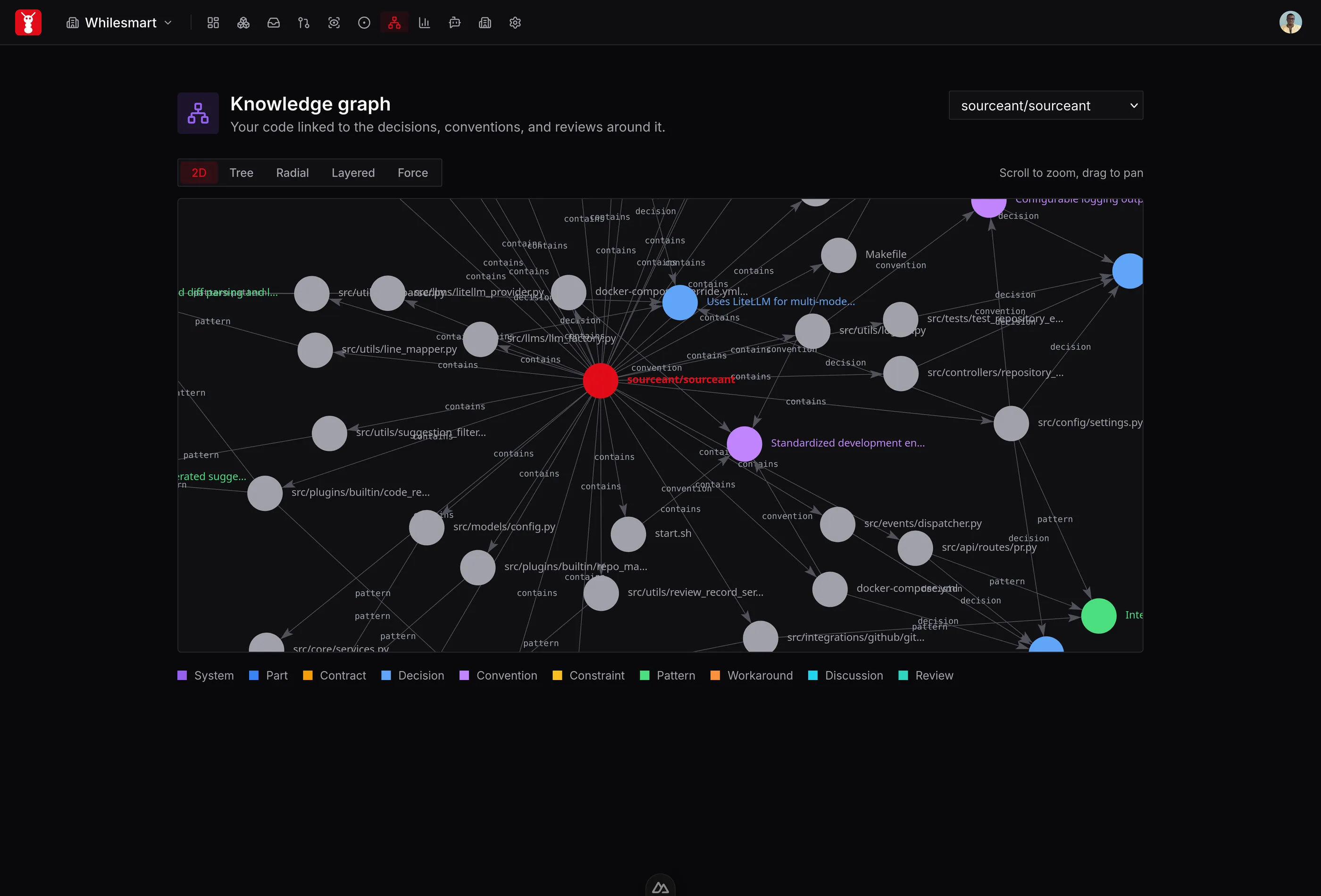
What you know, or should know, about the code. Keep decisions, constraints and conventions after the session that found them ends.

System graph

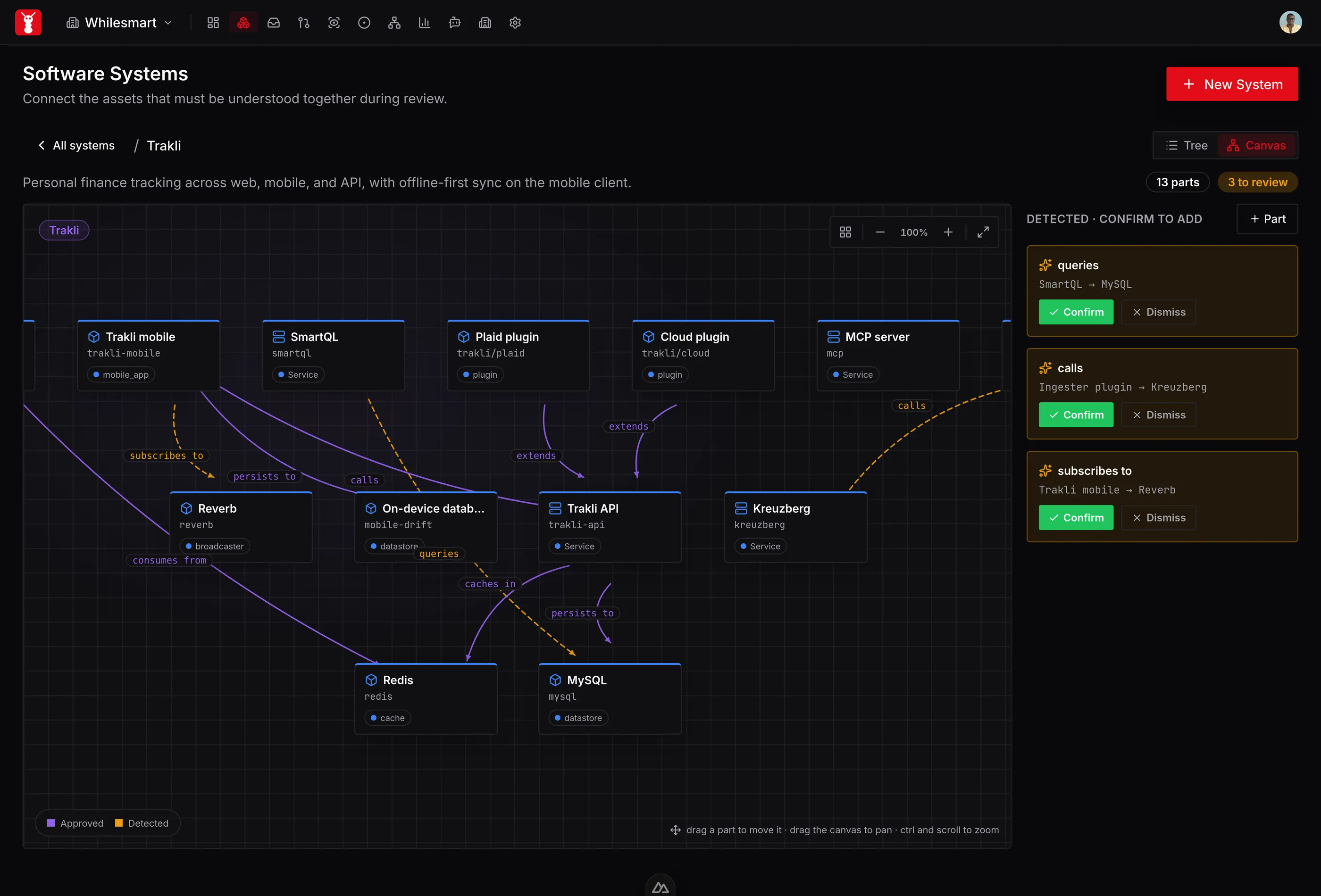
Living architecture documentation. See how services and datastores connect, where the architecture is moving, and whether you want it to go there.

Requirements graph

What the software is supposed to do, linked to the code and tests that carry it. Premium requirements engineering builds on the local foundation.

The whole system

Capture the knowledge once. Put it to work everywhere.

One living map of how your system works: your team sees where it is heading and steers it, your agents build with the full context, and the jobs you rely on run on top.

Code knowledge management

Understand your own system, and keep your agents on it

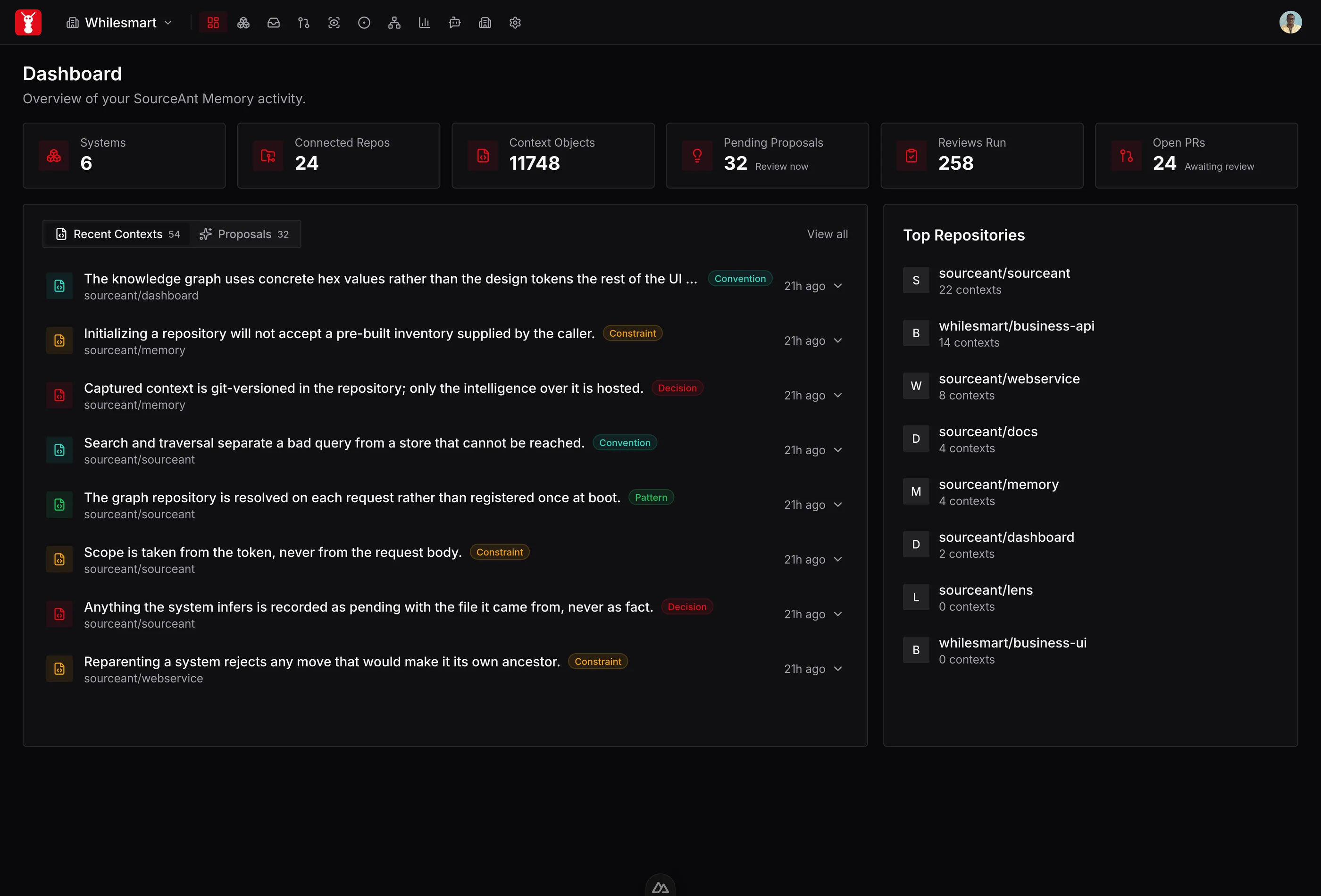
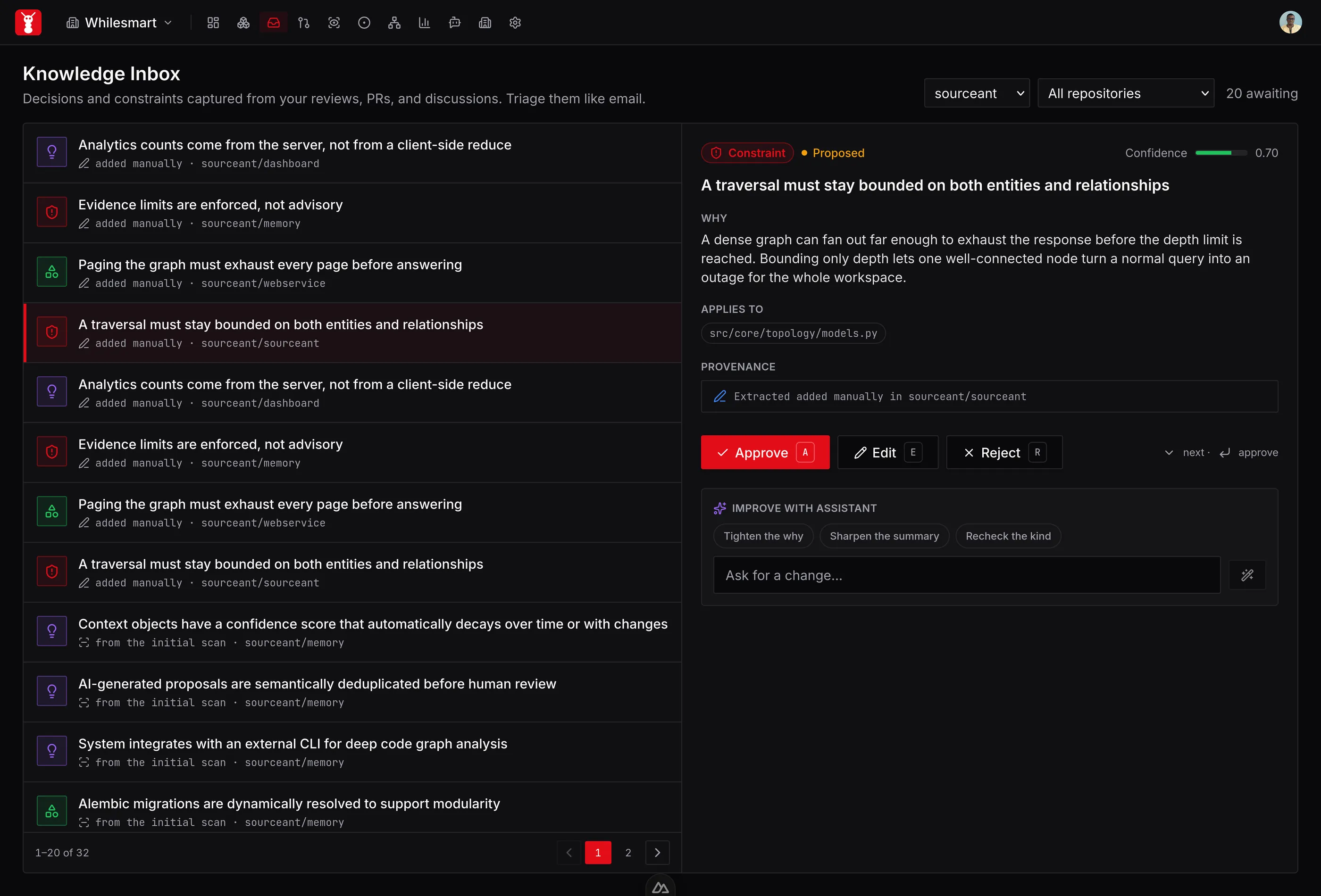
SourceAnt captures the decisions, constraints, contracts, and conventions behind your code and structures them into a living map of how your system actually works, one that stays current as the code changes.

For your team

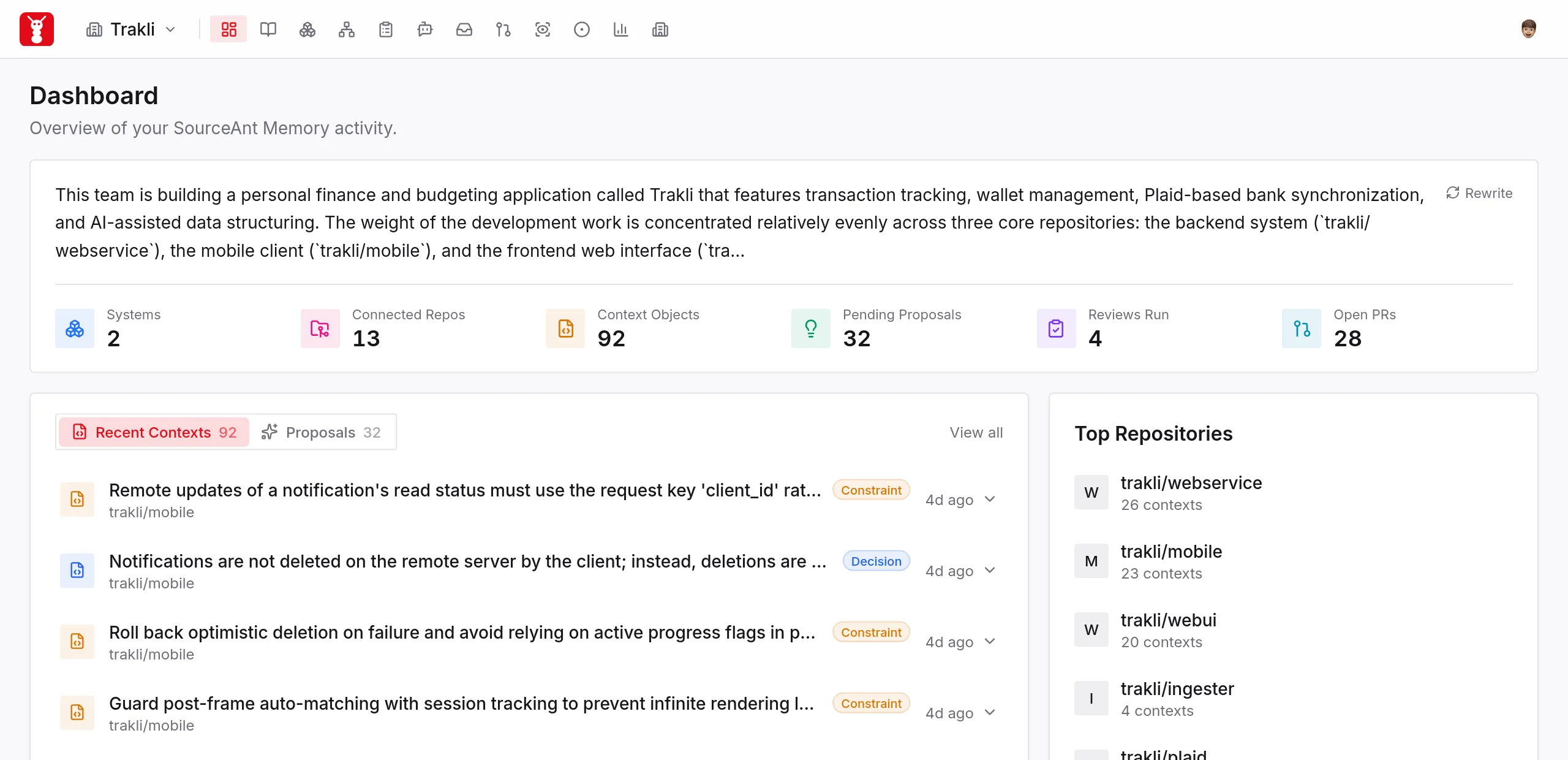
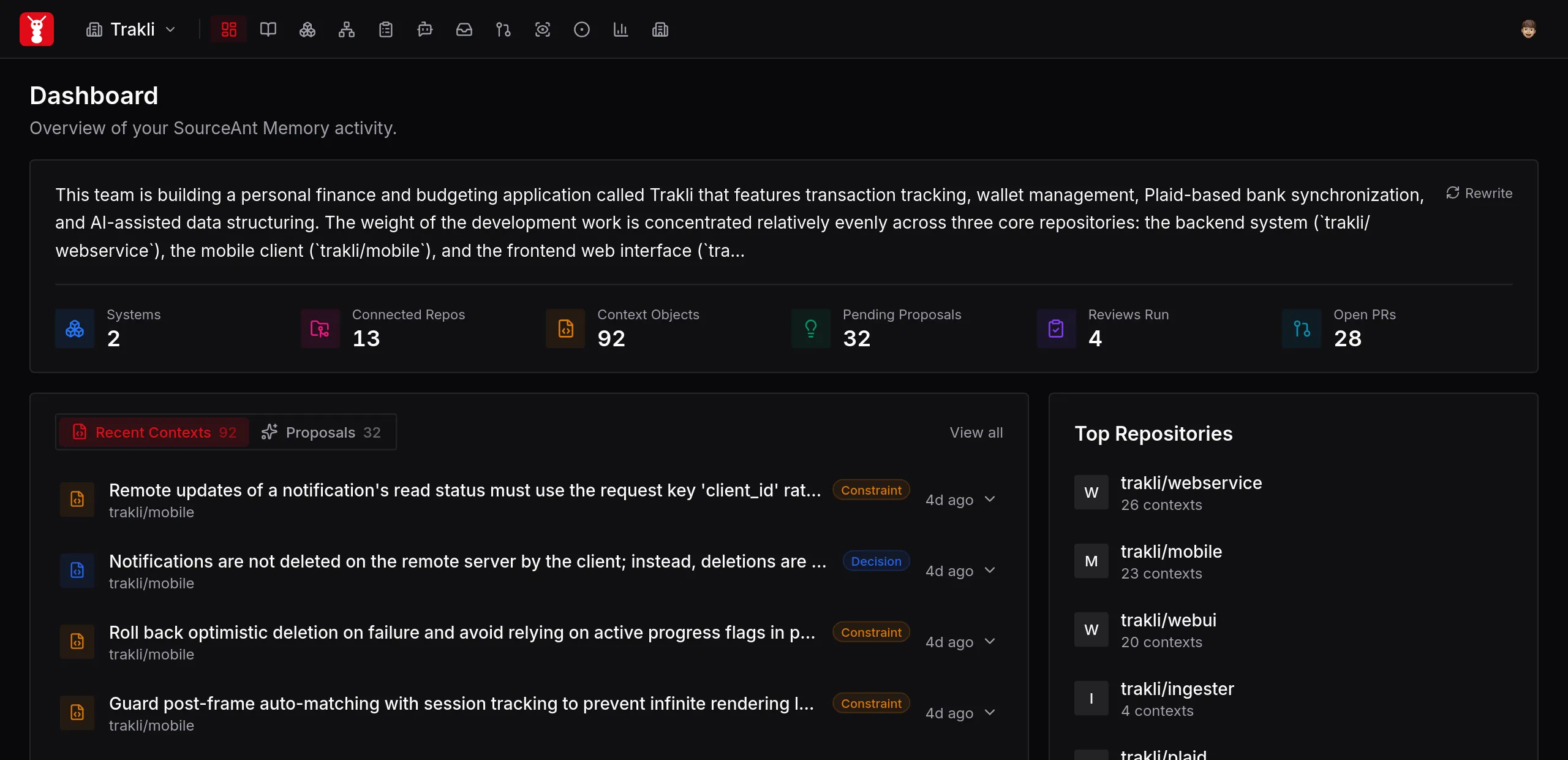
See how the system is built, how it is changing, and where it is heading, so you catch drift early and decide whether that is the direction you want before it is baked in.

For your agents

The relevant slice is served back over MCP the moment an agent acts, so it builds with the full why instead of guessing at it.

Context-aware review

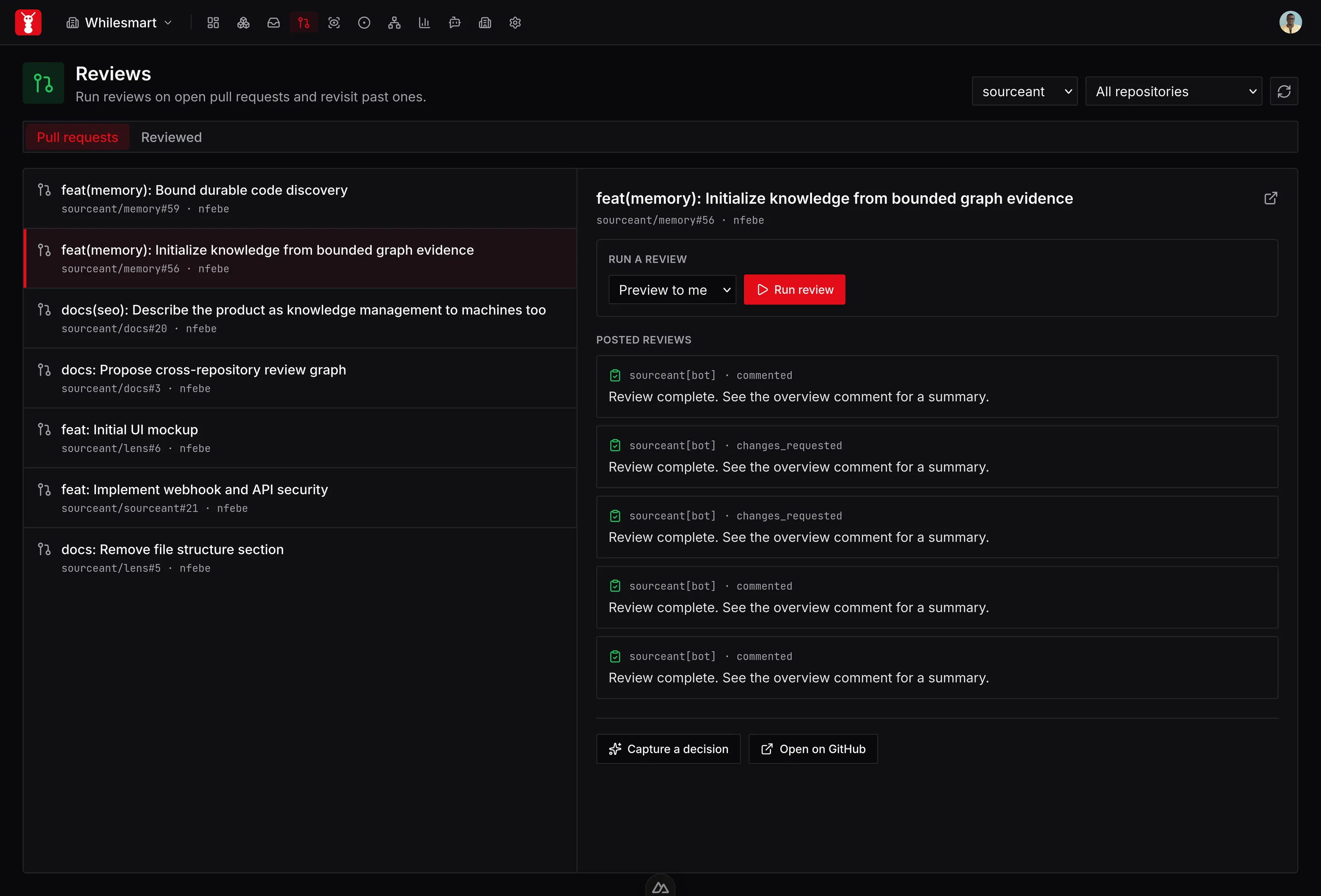
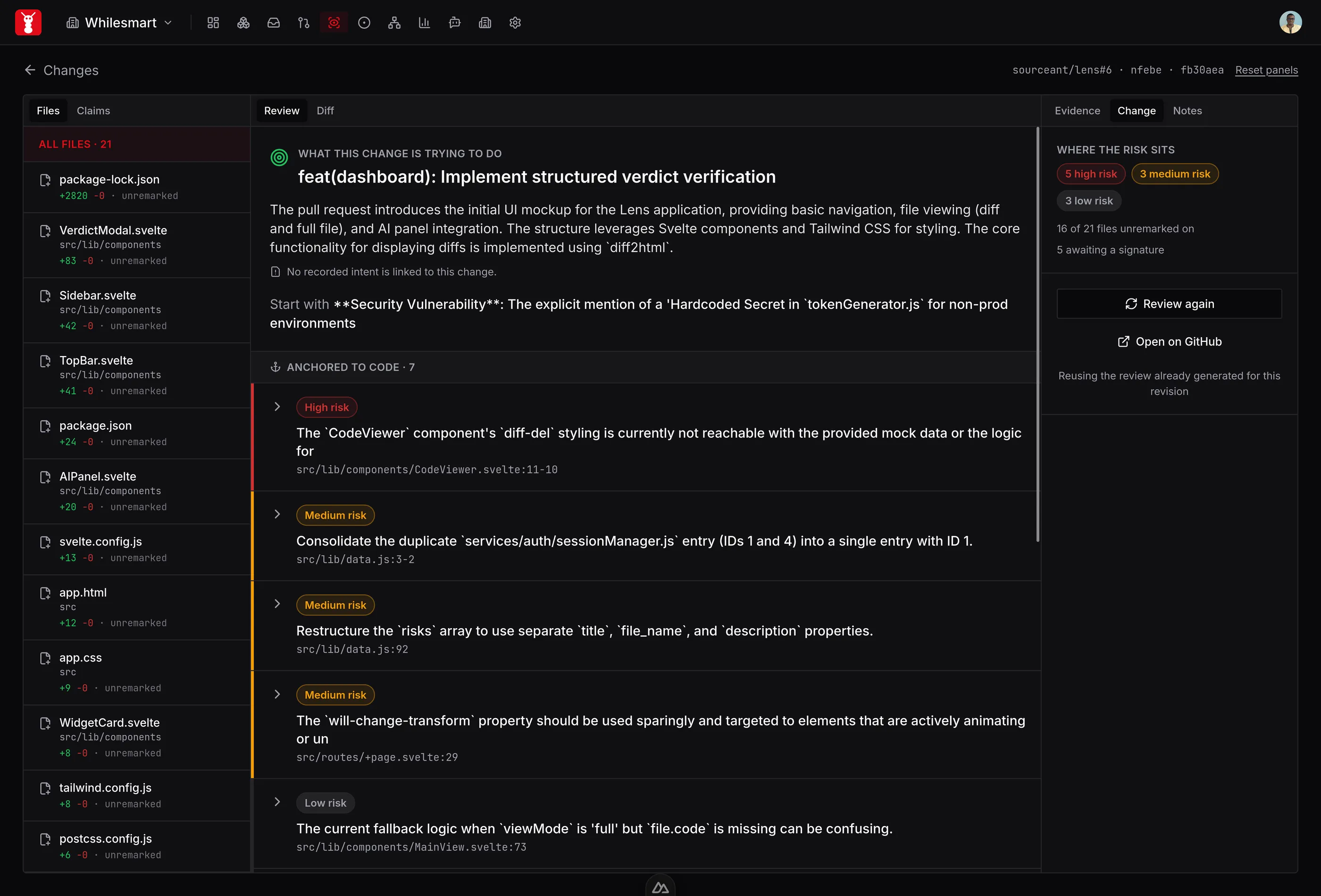
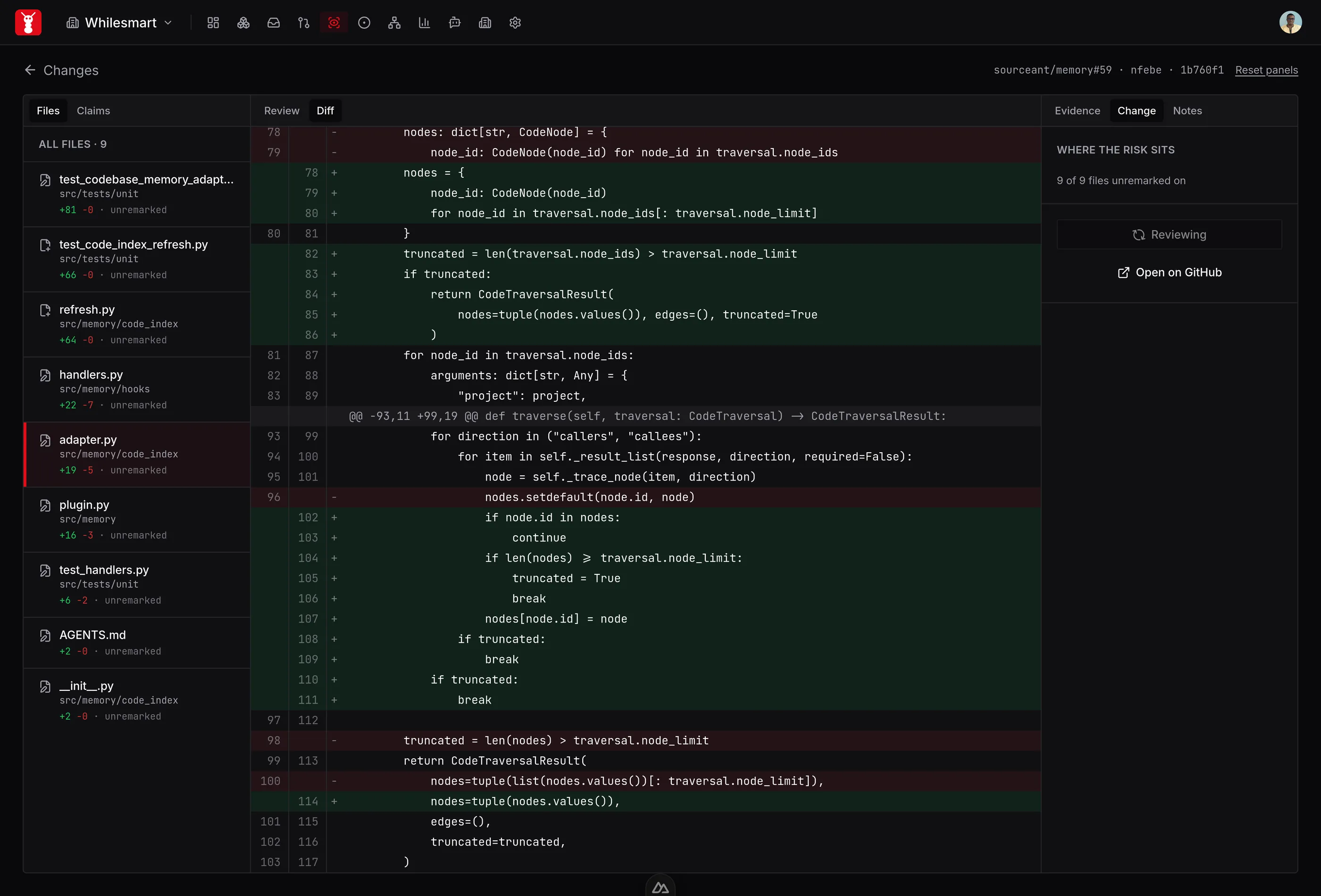
Check each change against your real decisions and its blast radius, so the bugs that read fine and the workarounds it wants to delete get flagged before they merge.

Issue triage

Duplicate detection and intelligent auto-labeling on issues and PRs, so your backlog stays deduped and routed without hand-sorting.

Engineering analytics

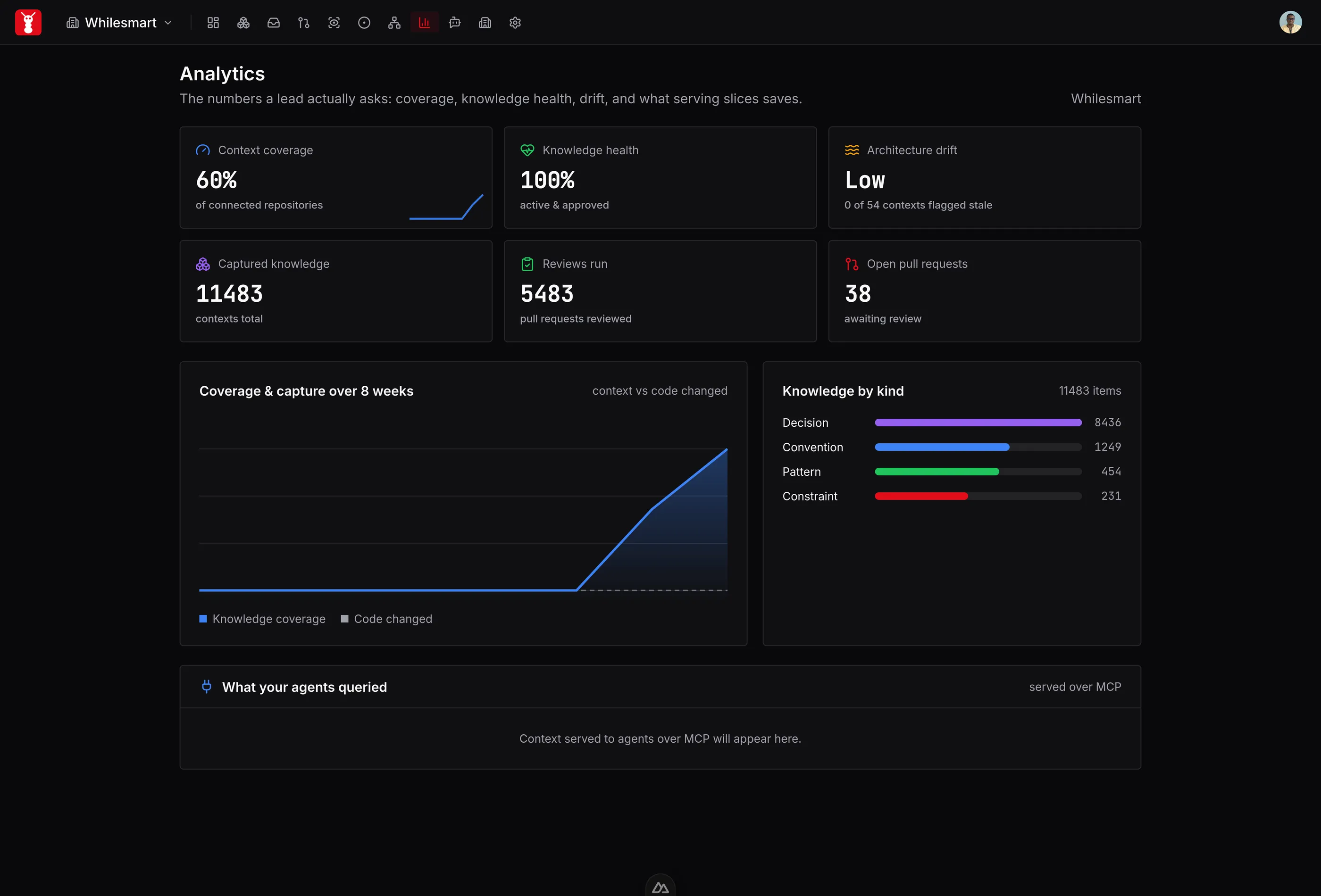
See token usage and savings, review quality, context coverage, and triage stats, so you can watch reliability and AI spend as you scale.

Portable

Works with the tools you already use

SourceAnt speaks MCP, so your context and every application show up in whatever your team codes with. And it is not just for humans: agents query the knowledge headlessly, mid-task, without anyone re-pasting context. No lock-in, no new habits.

Claude Code
Cursor
Codex
Zed
VS Code
Any MCP client

How it works

A graph, not a pile of text

Capture the why, link it into a knowledge graph, and serve only the relevant slice to any AI tool the moment it acts.

1. Map the code

Index your repositories into one code graph, so you and your agents can follow symbols and relationships across the code being changed.

2. Keep your intent

Record the decisions, constraints and requirements the software must continue to respect. Link them to the code and system parts they govern.

3. Use it before each change

Give the relevant context to your tools over MCP and review agent changes before they reach your colleagues.

Files linked to the decisions and conventions that explain them

In practice

The decisions your agent would otherwise undo

An assistant reads the code in front of it. It cannot read the incident that set the retry limit, or the discussion that ruled out jitter. SourceAnt hands it both before it writes.

An assistant is asked

Refactor the payment retry logic to use exponential backoff.

src/payments/retry.ts

SourceAnt answers with what that code already decided

Constraint from an incident review

Max retry stays at 3. Higher values caused duplicate charges once already.

Decision from a team discussion

Jittered backoff did not survive the rate limiter. The fixed delay is deliberate.

Contract from the mobile client

Idempotency keys are generated client-side. Changing that breaks the mobile app.

It ships the backoff and leaves the retry ceiling, the fixed delay, and the idempotency key where they are.

Served over MCP, so this works in whichever assistant your team already uses.

Illustrative example

Systems

Your architecture diagram is wrong. This one says so.

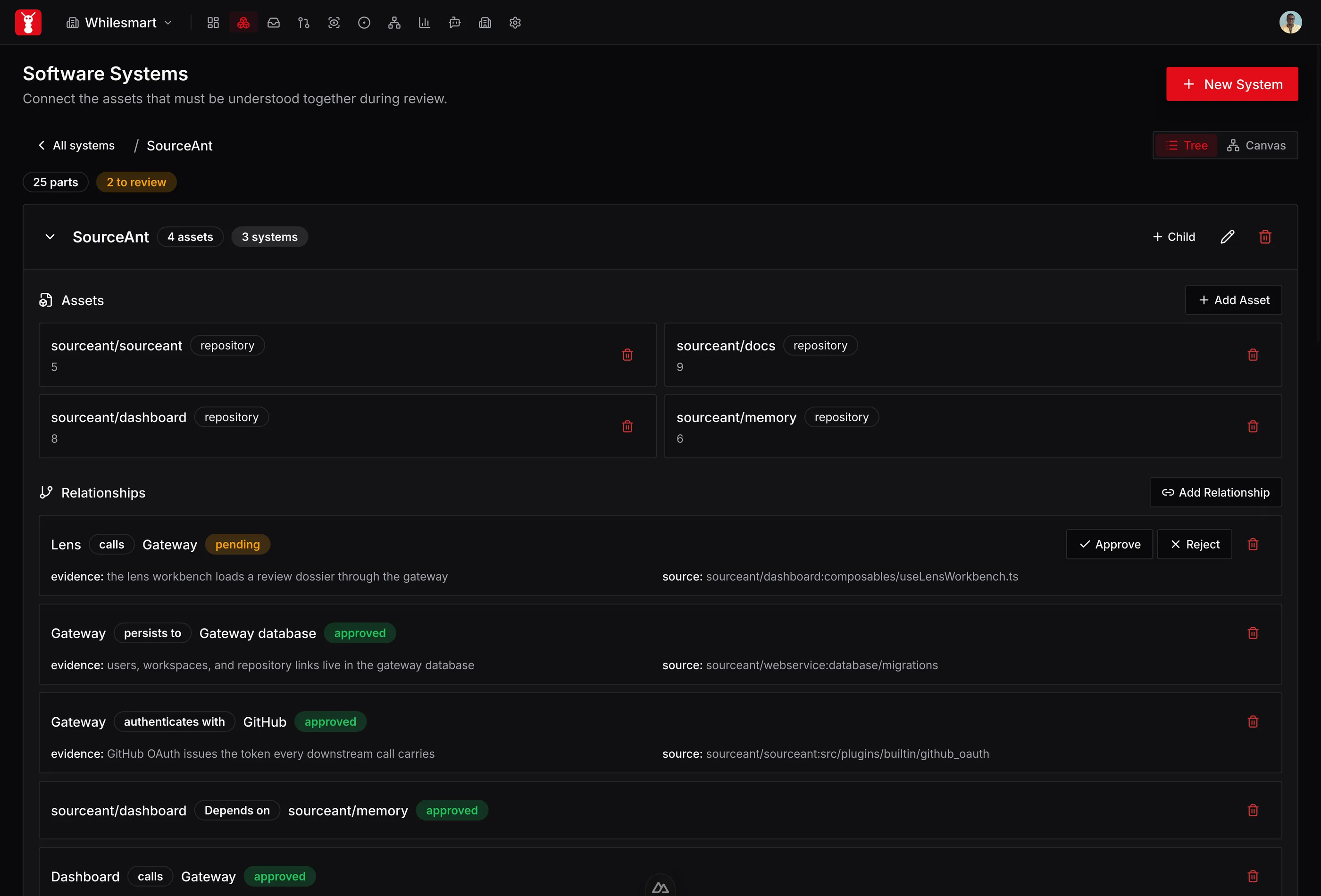
SourceAnt reads the manifests your repositories already publish, proposes how the parts depend on each other, and waits for a person to approve. When a part stops matching the code it is marked stale rather than left quietly wrong. Documentation that maintains itself, for the architecture instead of the help centre.

Read from five manifest files. Nothing cloned, nothing executed.

Every proposal is pending. Nothing here approves itself.

Every edge names the file it was read from.

A part that has aged is flagged, not silently believed.

A software system in SourceAnt showing its services, datastores, and the relationships between them, with pending proposals waiting for approval

Why SourceAnt

Why not comments, ADRs, a vector database, or another per-seat review bot?

Structured, not prose. Context is typed and linked in a graph, so tools retrieve the exact slice instead of grepping comments that have gone stale.

Governed, not hallucinated. Knowledge carries a status your team controls and your tools filter on: approval marks what the team vouches for, and it never queues capture behind a person. A vector store just guesses.

Portable and private. Served over MCP to any tool, open source you can self-host, with your own model keys. Your knowledge and your AI spend stay on your side, never in a vendor’s silo.

Priced for how you actually work. Usage-based and bring-your-own-key, one flat team price, no per-seat AI tax as you add engineers or agents.

How SourceAnt compares to Sourcegraph and graphify

Who it's for

For teams shipping fast with AI on code that cannot break

You run a large, critical codebase, you move at the pace of your agents, and you care as much about architecture and reliability as about velocity. You self-host, you want usage-based pricing and your own keys, and you need humans to keep understanding the system, not just the code.

The architect holding the why

You are the reason the system still hangs together. SourceAnt gets the decisions, constraints, and contracts out of your head and into a graph every tool and teammate can query, so the architecture survives the pace you are shipping at.

The platform lead who self-hosts

You run this on your own infrastructure, with your own keys, and you watch the AI bill. SourceAnt is open source, priced on what it analyses rather than on seats, and private by default, and it cuts tokens by serving only the slice a task needs.

The engineer on the hook

You are accountable when an agent’s change breaks production. SourceAnt judges each change against the real system and hands your tools the reasoning behind the code, so speed does not cost you trust.

Keep understanding your codebase at AI speed

Self-host the open-source core for free, or start SourceAnt Cloud at $49 a month. Every engineer and every agent you have, for the same price, with your own model keys if you want them.

1. Connect your repos 2. Approve what it captures 3. Everyone ships with the why